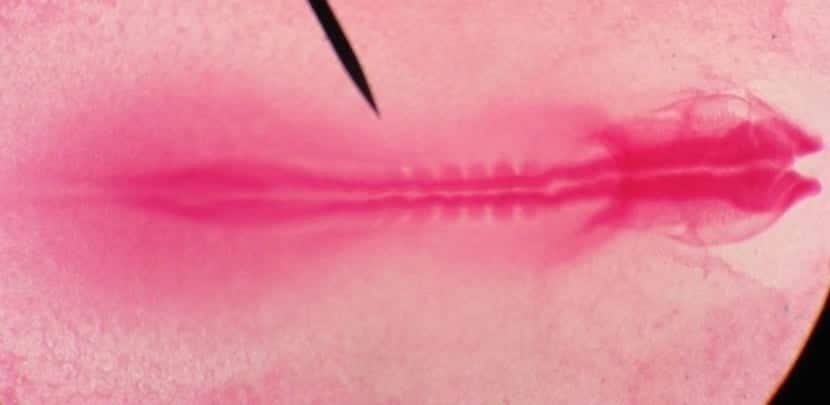
La week 5 of pregnancy It coincides with the first missed period in most women. 3 weeks have passed since fertilization and the embryo begins to develop vital structures at an impressive speed.
It is the beginning of the embryonic perioda very delicate stage in which the first organs of the baby, as already happens after the week 2 of pregnancyTherefore, it is essential that you avoid any toxic substances such as alcohol or tobacco or drugs And always consult your healthcare professional before taking any medication. If you are already taking any regular treatment, your doctor should monitor it to ensure it does not pose a risk to the baby's development.

What does the embryo look like in week 5?
At the beginning of this week, The embryo measures only between 1 and 2 millimetersabout the size of a sesame seed or a grain of rice. Despite its tiny size, it is already made up of three overlapping layers of cells which, between week 5 and 10 of pregnancy (3 to 8 weeks of actual development), will give rise to all the organs and systems of the baby's body, and later, in the week 15 of pregnancyMany of these systems will be more developed.
This set of layers is known as trilaminar germ disc and is made up of:
- Ectoderm: outermost layer from which the will form nervous system (brain, spinal cord), skin, hair, nails and part of the eyes.
- mesoderm: intermediate layer that will give rise to the muscles, bonescirculatory system, primitive heart, kidneys and part of the reproductive system.
- endoderm: innermost layer that will transform into most of the internal organs, such as lungs, stomach, intestines, liver or pancreas.
The formation begins around the middle of this week central nervous system with the appearance of neural tubea structure that will later give rise to the brain and spinal cord. For this process to be completed properly, a sufficient folic acid intakeTherefore, it is recommended to take a specific supplement prescribed by a healthcare professional.
The embryo gradually adopts a form of C-shaped curved tube and it still doesn't resemble a human being at all, although areas that will give rise to the head and trunkThe mesoderm cells begin to form the notochord, a structure that acts as the axis and initial support of the body until the spine is formed.
At the same time, the structures that will give rise to the placenta and umbilical cord They are evolving rapidly to achieve better support in the uterus. Currently, part of the nutritional intake comes through the yolk sacwhich will disappear when the placenta is fully functional, as occurs in later stages such as the week 25 of pregnancy.

Changes in the heart and other organs
In this phase, the embryo changes very rapidly, as if an adult were doubling in size every week. The flat disc it was just a few days ago "coils up" and takes the shape of a tube that already resembles a very primitive living being. There are no defined limbs yetBut small bulges can already be seen that will later become arms and legs.
The heart is one of the structures with earlier developmentSome cells around the blood vessels become cardiac muscle and they begin to contract rhythmically. In this way, the The primitive heart begins to pump bloodAlthough it is still very simple and will become more complex as the weeks go by.
Red blood cells are initially manufactured in the yolk sacwhich acts as a temporary blood factory. Thanks to the heartbeat, oxygen and nutrients can reach all the cells of the embryo more effectively, allowing for its rapid growth.
When to take the pregnancy test
Once the first missed period appearsA good time to take a urine pregnancy test is after 4 or 5 days lateFrom that moment on, the structure that will later become the placenta begins to secrete a significant amount of the pregnancy hormone, the hCG hormonewhich is eliminated through urine and is easily detectable with current tests.
Your pregnancy test will almost certainly be positive, except in situations of very irregular rules or if implantation was somewhat delayed. There are different types of tests: some collect urine in a cup and a test strip is inserted, while others involve placing the stick directly into the urine stream. The most sensitive tests detect small amounts of hCG And the pharmacy can advise you on which one to choose.
If they go out two red stripes It means you're pregnant; if only one line appears, the result is negative. When one line is very dark and the other is barely visible, it usually indicates a very early pregnancyIt is also possible that the test is negative and yet there is a pregnancy because the hCG levels are still low; in that case, it is advisable to wait a few days and repeat the test if menstruation still does not appear.
When the test is positive, it's a good time to consult with your GP and start making an appointment with your midwife or gynecologist to begin prenatal care and resolve your initial doubts.
Ultrasound at 5 weeks of pregnancy
The ultrasound that clearly confirms the progress of the pregnancy is usually recommended from the week 6 or 7However, by week 5 it may already be visible. gestational sac inside the uterus, a small fluid-filled sac where the embryo will develop.
The presence of this sac, along with adequate hCG levels in the blood, confirms that it is a intrauterine pregnancy, something especially important to rule out a ectopic pregnancyIn some cases it is also possible to see the yolk sac inside the gestational sac, which indicates that there is an embryo even though it is not yet clearly visible.
However, performing an ultrasound too early can lead to unnecessary anxietyAt 5 weeks, it's very common to see only the gestational sac without a defined embryo, which can mistakenly lead to a suspicion of an anembryonic pregnancy. That's why many specialists prefer wait one or two weeks to repeat the ultrasound and assess the evolution more clearly.
At this stage, the primitive heart may be beginning to form, but The heartbeat is not usually detected yet It is safe to say. It is usually possible to hear it from week 7 onwards, depending on the type of ultrasound machine and the route used (abdominal or transvaginal).

Symptoms of week 5 of pregnancy
Perhaps, for the time being, You barely notice any symptomsAlthough some mothers are already starting to notice clear changes, there is a great deal of variability: some women experience intense discomfort while others barely feel anything, and both cases can be completely normal.
One of the most frequent signs is the chest tendernessYou may notice increased size, heaviness, or unusual sensitivity in your nipples. Your breast tissue is preparing for breastfeeding, so these sensations are a normal hormonal response.
It's also common to start noticing discomfort in the lower abdomenSmall twinges, a feeling of bloating, or the feeling that menstruation will start at any moment. These are sensations typical of menstruation. implantation and adaptation of the uterus to the pregnancy and, in general, indicate that everything is progressing as expected.
Other common symptoms in week 5 include intense tiredness, the most frequent urge to urinate, the morning sickness (which can appear at any time of day) and a heightened sensitivity to smells or mood swings. Fluid retention is also common and can make you feel more bloated than usual.
If it appears Intense painIf you experience fever or heavy bleeding, especially bright red blood, it's important to consult a specialist to rule out possible complications such as threatened miscarriage, ectopic pregnancy, or other problems. If you have any doubts, a professional evaluation is always the best option.
Why have I already gained weight?
As soon as the pregnancy test is positive, one of the first things most women do is weigh themselves, and suddenly, horror! We're already registering one or two kilos more than usual. Don't panic: This weight gain is not entirely realbut is mainly due to the fluid retention.
This retention is necessary to cope with the increased blood volume and other changes typical of pregnancy. In fact, every month before menstruation we usually retain fluids and gain between 500 and 2000 grams to prepare the body for a possible pregnancy, weight that is then lost in the days following menstruation.
Keep taking a pregnancy-specific vitamin complex if your healthcare professional has advised it, and maintain a balance diethealthy life and moderate exercise Adapted to your condition. Try to limit excess salt and ultra-processed foods to help control fluid retention.
Those extra two kilos, in most cases, correspond to normal physiological adaptations and not to accumulated fat. With good habits during pregnancy and postpartum, the body will gradually regain its weight, and the retained fluid will be eliminated.
This stage marks the real start From the journey of pregnancy: the embryo begins to organize its organs, your body adjusts to a new hormonal reality, and you begin to take key decisions For your health. Listening to your body, relying on your healthcare team, and maintaining healthy habits are the best foundations for facing the coming weeks with peace of mind and preparing for later stages such as... week 35 of pregnancy.